Key Planning Considerations for Biscayne Bay Core Events
Biscayne Bay district routing patterns and urban access timing
Venue-specific guidelines for conference hotel operations
Integration with Miami-Dade and Broward regional convention assets
Selection from GMCVB-listed suppliers across specialized categories
Freight timing and exhibitor-appointed contractor protocols
District-level differentiation from Miami Beach and airport clusters
Incorporation of nearby cultural and sports venues into programming
Miami planning context
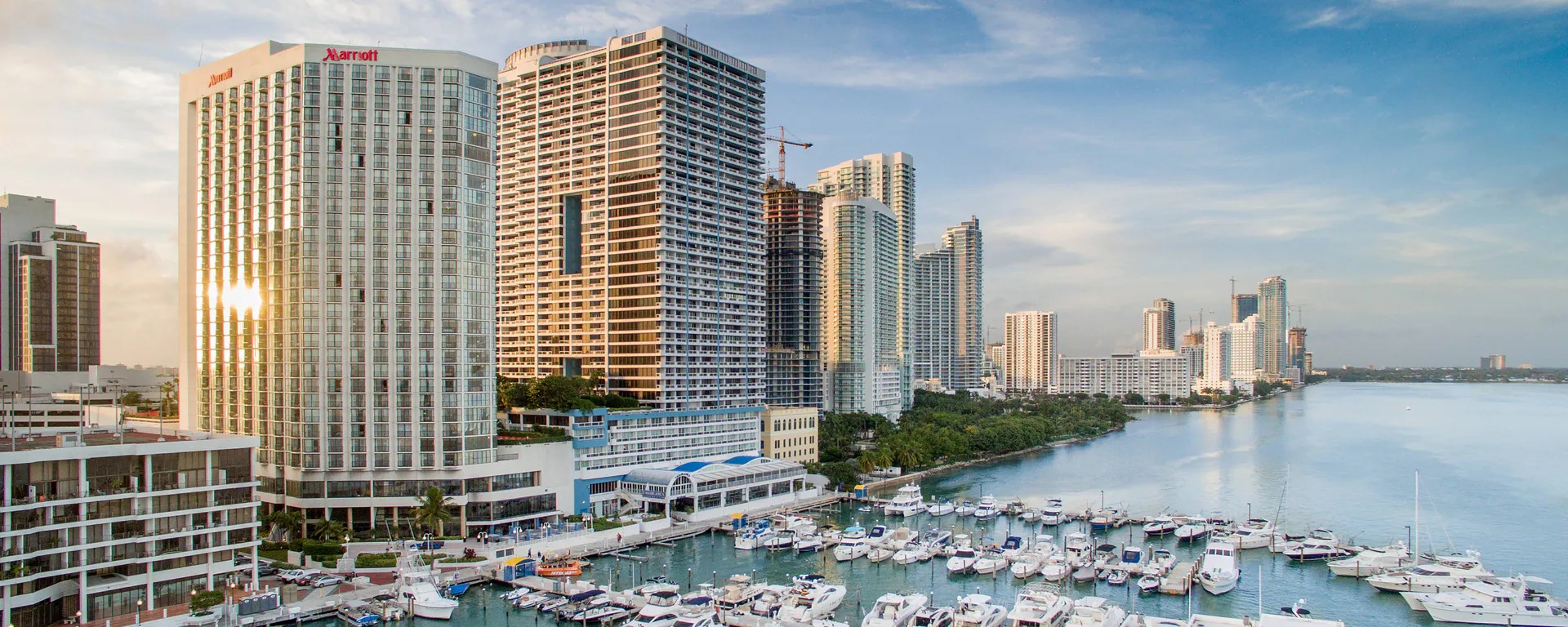
The Miami Marriott Biscayne Bay occupies a strategic position in Miami's downtown, Brickell, and Biscayne Bay core cluster at 1633 N. Bayshore Drive. This conference hotel delivers waterfront views and convenient access to the urban business environment, making it suitable for executive meetings, product launches, sponsor activations, and specialized corporate events that benefit from a focused scale rather than mass exhibition floor space.
Planners working in this district gain from proximity to cultural institutions and sports venues while operating within the connected South Florida meetings region that includes the Miami Beach Convention Center's 1.4 million square feet of meeting space and 500,000 square feet of exhibit space alongside the Miami Airport Convention Center and Broward County Convention Center. the property's 360-degree views from private balconies and steps-away access to the Adrienne Arsht Center for the Performing Arts and Miami-Dade Arena support multifaceted program design.
Coordination at this venue centers on its specific operational characteristics, alignment with neighborhood routing realities, and utilization of the documented Greater Miami supplier ecosystem for services ranging from audio-visual support to transportation and catering.
Venue Context Within Miami's Meetings Ecosystem
The Miami Marriott Biscayne Bay functions as an established conference hotel in the Edgewater neighborhood along Biscayne Bay. Official Greater Miami listings position the property for events that capitalize on its waterfront setting and central urban location. This placement supports programs requiring professional meeting infrastructure combined with easy connections to downtown Miami, Brickell financial centers, and adjacent cultural destinations.
Within the four primary venue clusters serving South Florida, this property aligns with the Downtown, Brickell, and Biscayne Bay Core. the cluster emphasizes investor meetings, product launches, sponsor experiences, and high-density corporate gatherings that thrive in an urban bayside environment. This differs markedly from the Miami Beach Convention and Collins Corridor led by the Miami Beach Convention Center's nearly 500,000 square feet of versatile exhibit space, 60,000 Square Foot Grand Ballroom, and 84 breakout rooms.
The airport-west belt offers distinct advantages for programs with substantial freight demands and easier trucking routes, while the north coastal extension accommodates resort-style overflow and luxury hospitality. Recognition of these differentiated roles enables precise venue selection that matches program objectives with the most appropriate district characteristics and operational realities.
Planners benefit from treating Miami-Dade and Broward counties as a single connected operating region. This perspective facilitates smooth management of multi-venue campaigns, overflow attendance, or sequential events that move between clusters based on specific scale and audience requirements.
1633 N. Bayshore Drive, Miami, FL 33132
Edgewater neighborhood on Biscayne Bay
Official listing with Greater Miami Convention and Visitors Bureau
Proximity to Adrienne Arsht Center and Miami-Dade Arena
Part of connected South Florida meetings region
Supplier Ecosystem and Service Coordination
The Greater Miami Convention and Visitors Bureau maintains a detailed supplier directory that organizes resources into clear categories including audio-visual and film services, caterers, destination management companies, transportation providers, employment services, and entertainment booking. Events at the Miami Marriott Biscayne Bay draw from this ecosystem to assemble the precise mix of capabilities required for each program.
This vendor-network approach reflects the market's structure as a mixed-supplier environment rather than one governed by uniform venue rules. Experienced coordinators identify partners whose expertise aligns with the technical, logistical, and experiential elements of their specific event while confirming compatibility with the hotel's operational framework.
Early mapping of required services, verification against current venue documentation, and establishment of communication protocols contribute to efficient execution. the documented breadth of high-quality suppliers enables flexible responses to varying program scopes, from intimate executive sessions to events that incorporate exhibition components or large-scale receptions.
Coordination resources stress the importance of building these supplier relationships on documented performance standards and clear contractual terms. This methodical process supports consistent outcomes across different properties throughout the Miami and Broward meetings landscape.
Audio-visual and presentation technology services
Specialized catering and culinary partners
Destination management companies for logistics
Transportation and material handling providers
Staffing and employment service options
Entertainment and talent booking resources
Labor, Services, and Venue-Driven Management
Labor and outside-vendor access in the South Florida market follow venue-specific, show-specific, and manual-driven parameters. the Miami Marriott Biscayne Bay maintains its own guidelines for house services, exhibitor-appointed contractors, and permitted external support. Planners must consult the current event documentation and venue meetings team to define exact requirements for each program.
Official South Florida venue resources frame planning around each property's individual event platform. This approach avoids assumptions about universal rules and instead emphasizes direct alignment with the documented conditions at the Miami Marriott Biscayne Bay or any other selected location. the same principle applies whether an event occurs at a convention center, airport facility, or bayside conference hotel.
The regional supplier ecosystem provides additional flexibility for AV, catering, transportation, staffing, and related services. These resources operate within the parameters established by the venue and event organizer, enabling coordinators to address technical and logistical needs without relying on any single blanket labor model.
Documentation of all agreements, maintenance of communication channels, and incorporation of appropriate scheduling buffers remain central to professional management. This disciplined methodology reduces operational friction and supports smooth delivery regardless of the particular labor configuration required for a given event.
Logistics and Neighborhood Operational Details
The Biscayne Bay district presents distinct logistical characteristics tied to its urban waterfront location. Bayshore Drive and surrounding routes experience traffic patterns influenced by downtown Miami activity, events at nearby cultural venues, and arena schedules. Attention to these neighborhood-specific factors informs realistic freight timing, material delivery windows, and setup sequencing.
Market resources consistently highlight the value of addressing loading realities, neighborhood routing, exhibitor-appointed contractor coordination, freight timing, and venue-specific services when planning events with any exhibition or equipment components. These considerations take on added importance in the tighter urban footprint of the Biscayne Bay core compared with the more industrial access available in the airport-west cluster.
Effective planning incorporates early mapping of all movement requirements, development of contingency timelines, and regular updates with transportation and logistics partners. This preparation helps maintain program integrity even when overlapping events in the downtown and bayside area create temporary congestion or scheduling pressure.
The differentiation between clusters planning notes these decisions. Properties in the Biscayne Bay core prioritize proximity to business and cultural amenities while the Miami Beach corridor and Broward spillover venues offer different scale and access profiles. Understanding these nuances allows coordinators to optimize material handling and personnel deployment for each selected location.
Account for downtown and bayside traffic patterns
Align deliveries with hotel loading specifications
Coordinate with exhibitor-appointed contractors per manual
Incorporate buffer time for urban routing variables
Reference official venue guidelines for all logistics
Program Design and Attendee Experience Integration
The Miami Marriott Biscayne Bay's official description emphasizes breathtaking 360-degree views available from private balconies and the opportunity to explore Miami's active neighborhoods. These attributes support program designs that blend structured business sessions with memorable experiential elements. Planners frequently incorporate evening activities at the Adrienne Arsht Center for the Performing Arts or attendance at Miami Heat games at the nearby Miami-Dade Arena.
This capacity for integrated programming distinguishes conference hotels in the Biscayne Bay core from pure exhibition facilities. Events can transition smoothly from daytime meetings with waterfront backdrops to cultural or sporting experiences that reinforce themes, strengthen relationships, or provide shared memories for participants. Such approaches align with current expectations for events that deliver both professional outcomes and distinctive hospitality.
When part of larger regional activity, programs at this property can function as executive extensions, hospitality suites, or specialized tracks connected to major conventions at the Miami Beach Convention Center or Broward County Convention Center. the 350,000 square feet of contiguous exhibit space at the Broward facility and the Miami Airport Convention Center's 100,000 square feet of exhibition space offer scale options that complement the more targeted environment at the Miami Marriott Biscayne Bay.
Successful designs begin with clear definition of objectives, followed by mapping of how the venue's location and nearby attractions can enhance achievement of those goals. This integrated perspective maximizes the unique attributes of the Biscayne Bay district while maintaining operational precision.
Strategic Alignment with Regional Convention Assets
Miami's trade show economy draws strength from the complementary capabilities of its varied venue clusters. the Miami Marriott Biscayne Bay serves programs that benefit from the downtown core's business density and cultural offerings while the primary convention activity often centers on the Miami Beach Convention Center's extensive facilities or the Broward County Convention Center's expansion plans that reference future capacity above 1.2 million square feet.
Coordinators who understand these relationships can construct comprehensive regional strategies. an event at the Miami Marriott Biscayne Bay might host leadership sessions or client hospitality that support a larger exhibition occurring elsewhere in the market. This layered approach leverages the full depth of South Florida's meetings infrastructure without forcing every program into a single venue type.
The GMCVB's supplier section and venue listings provide foundational references for building these integrated plans. by drawing on documented resources rather than assumptions, planners create realistic timelines, accurate budgets, and clear accountability across multiple partners and locations.
Long-term success in this market depends on methodical attention to each venue's parameters, consistent use of qualified suppliers, and ongoing refinement of coordination processes. the Miami Marriott Biscayne Bay represents one valuable component within this broader ecosystem of differentiated meeting and exhibition options.
Complements Miami Beach Convention Center scale
Supports targeted corporate and launch programs
Connects to Broward County overflow capacity
Utilizes documented supplier categories
Enables multi-venue regional event architecture
Practical Coordination Framework for Future Programs
Developing a reliable coordination framework for the Miami Marriott Biscayne Bay begins with thorough review of the venue's current guidelines and the specific requirements of the organizing body. This foundation informs all subsequent decisions regarding supplier selection, timeline development, and resource allocation within the Biscayne Bay district.
The market's emphasis on venue-driven management encourages early engagement with the hotel's meetings team and careful documentation of all operational agreements. These steps create clarity for every participant and establish measurable checkpoints throughout the planning and execution phases.
Incorporation of the broader supplier ecosystem adds depth and flexibility. Whether the program requires advanced presentation technology, specialized catering, or efficient transportation between the hotel and nearby attractions, qualified providers listed through official channels stand ready to support execution while operating within the established venue parameters.
By maintaining focus on district-level nuances, operational details, and factual resources from the Greater Miami Convention and Visitors Bureau, coordinators position their events for professional delivery and positive attendee outcomes in one of the nation's most active meetings destinations.
Frequently Asked Questions About Miami Marriott Biscayne Bay Planning
Q: What is the address and primary location of the Miami Marriott Biscayne Bay?
The Miami Marriott Biscayne Bay is located at 1633 N. Bayshore Drive, Miami, FL 33132, in the Edgewater neighborhood within the Downtown, Brickell, and Biscayne Bay core cluster. the property overlooks Biscayne Bay and is noted for 360-degree views and proximity to the Adrienne Arsht Center and Miami-Dade Arena.
Q: How does the Biscayne Bay core differ from the Miami Beach convention district?
The Biscayne Bay core supports conference hotels suited for corporate meetings, product launches, and targeted activations in an urban waterfront setting. the Miami Beach district is led by the Miami Beach Convention Center offering 1.4 million square feet of meeting space, nearly 500,000 square feet of exhibit space, and 84 breakout rooms for large-scale events.
Q: How should labor and vendor coordination be approached?
Labor and service arrangements follow venue-specific guidelines and the individual event manual. the South Florida market operates on a mixed supplier ecosystem model with final conditions determined by the property, show organizer, and current documentation rather than any universal rule set.
Q: Can nearby attractions be integrated into programs at the this work?
The venue's official description highlights steps-away access to the Adrienne Arsht Center for the Performing Arts and the Miami-Dade Arena. Planners often incorporate performances, games, or related experiences to create comprehensive attendee programs that combine business sessions with cultural and sports elements.
Q: How does this hotel fit into larger regional conventions?
The Miami Marriott Biscayne Bay serves as a complementary venue for executive sessions, hospitality, or specialized tracks that support major exhibitions at the Miami Beach Convention Center, Miami Airport Convention Center, or Broward County Convention Center with its 350,000 square feet of exhibit space.